

Fiber and Gut Health: Beyond “High-Fiber” Claims
Gut health is central to the wellness conversation, and for a clear reason: Consumers connect gut health to their overall health, with 3 out of 5 consumers saying gut health is very important for their whole body.1 Their interest is driving this market as global food and beverage launches with a gut health claim grew by 61% in 2025.1
But what really is gut health? An expert panel convened by the International Scientific Association for Probiotics and Prebiotics defined gut health as “a state of normal gastrointestinal function without active gastrointestinal disease and gut-related symptoms that affect quality of life.”2
Gut health acts as an umbrella term that encompasses several components of digestion, including regularity and comfort, and the ecosystem of the gut microbiome. For today’s consumer, achieving balance under this umbrella is no longer just about fixing occasional bloating or digestive discomfort. It has become a pathway to broader wellness goals.
The Whole-Body Connection
When consumers think about a healthy gut, they associate it with a diverse range of whole-body wellness outcomes. In fact, over half of consumers believe that weight management and stress relief are related to gut health.1
Today, this whole-body connection extends to several key wellness areas:
- Immunity
- Energy levels
- Nutrient absorption
- Sleep
- Satiety
- Mental well-being
Despite these associations with gut health and wellness, few consumers actively work on improving their gut health.1 Many just look for fiber and probiotics without fully grasping their connection or understanding what they do. This creates an opportunity for brands to educate consumers and distinguish their gut health products by highlighting specific, science-backed wellness benefits.
Fiber: Focus on Quality, Gut Health and Tolerance
Fiber is a leading gut health ingredient, with 38% of gut health launches claiming to contain fiber in 2025.1 However, its role in the gut health market is shifting away from generic “high-fiber” claims. To connect with today’s health-conscious consumer, brands should focus on fiber quality, educating the consumer on specific fiber types, benefits and how they uniquely fit under the broader gut health umbrella.3
Different fibers drive distinct gut health outcomes:
- Soluble fiber: adds bulk to loose stools or soften firm ones
- Insoluble fiber: helps with digestive regularity
- Prebiotic fiber: fermented by beneficial gut bacteria to help balance the gut microbiome
Digestive comfort plays a critical role in how well a fiber fits into a consumer’s daily gut health routine. Rapidly fermented fibers can lead to bloating, gas and digestive discomfort, creating a need for well-tolerated fiber ingredients with proven gut health benefits.
Formulating for Success with Fibersol®
To deliver science-backed prebiotic benefits without digestive discomfort, formulators need a proven functional ingredient solution. With over 30 years of extensive clinical research, Fibersol® prebiotic dietary fiber offers clear advantages:
True Prebiotic Support: Not all fiber is prebiotic. Only fiber that can be metabolized by beneficial gut microbes, like Fibersol®, is prebiotic.
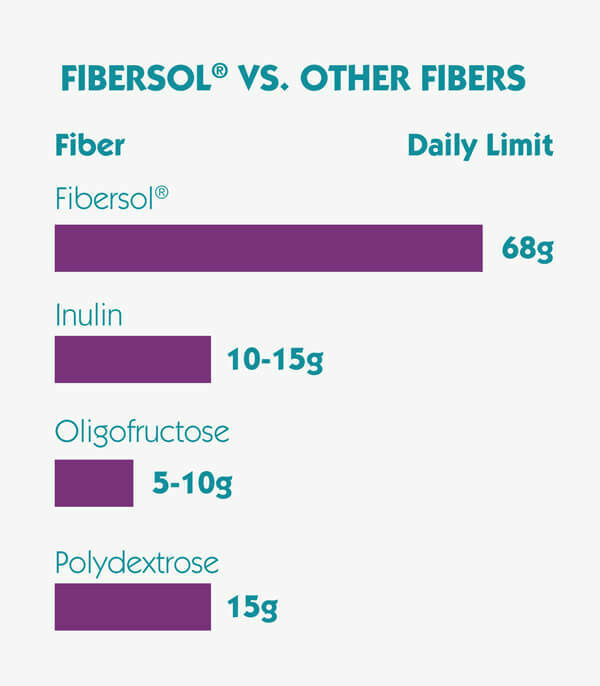
Slower Fermentation: Since Fibersol® is fermented in the colon at a slower rate compared to other soluble fibers such as inulin or oligofructose, it helps minimize bloating and gastric discomfort.
Well Tolerated: Fibersol® has been shown to be well tolerated up to 68g per day—over 4x that of inulin.
Science You Can Trust
With clinically backed, claim-ready benefits, Fibersol® can help your gut health products get to market faster.
Digestive Health
At 4-8g per day (for 2 weeks), Fibersol®
- Helps support/maintain intestinal regularity
- Helps relieve occasional constipation
- May support gut health
- Improves stool consistency
Prebiotic Claims:
At 3.25g per serving, Fibersol®:
- Enables “Prebiotic Fiber” claim on products (2.8g fiber from Fibersol® corresponding to 10% DV for fiber)
At 3.75g per serving (4x per day), Fibersol®:
- May help nourish the intestinal flora and maintain a healthy intestinal tract environment (for a total of 15g per day over 3 weeks)
- Is a clinically studied, well-tolerated prebiotic
Add the Fibersol® advantage to your next gut health formulation.
Sources
1 Innova Market Insights. Gut Health Trends: #2 Top Global Trend for 2026.
2 International Scientific Association for Probiotics and Prebiotics. https://isappscience.org/resou...
3 Mintel. Myth vs Reality: Rethinking Ingredients and Claims in Food and Drink. April 2026.