
Revisiting Sugar Reduction
As food and beverage manufacturers formulate for evolving consumer demands, one reality remains consistent: Sugar is still the top ingredient that consumers are actively trying to limit.
Far from being a niche health trend, three in four Americans are now trying to avoid or limit sugars in their diet, with more than six in ten expressing concern over their total sugar consumption. Among the 75% of Americans who say they are trying to limit or avoid sugars, 63% are targeting added sugars with far fewer (13%) trying to reduce their intake of natural sugars.1
For formulators, helping consumers meet their sugar reduction goals presents challenges. Today’s consumers are no longer just looking to cut sugar. They are pursuing a holistic approach to wellness without sacrificing the sensory experiences of food and beverages. This heightens the pressure on brands to reduce sugar content while meeting the taste profile, textural properties, and simple ingredient statements that consumers expect.
What’s Driving Today’s Shopper?
To successfully formulate for these consumers, it helps to understand that the motivations driving sugar reduction have evolved from simple weight management. Consumers globally view sugar reduction as a proactive tool for both physical and emotional well-being.2
Primary drivers include:2
- Weight Management: Managing caloric intake remains a foundational goal
- Energy: Avoiding sugar crashes to sustain energy
- Emotional Wellness: Supporting less stress
- Sleep: Improving sleep quality
- Healthy Aging: Supporting quality of life in later years
As consumers pursue these goals, their everyday purchasing strategies shift. Thirty percent now actively use the Nutrition Facts Panel to select items with less added sugar, 27% choose products explicitly labeled “reduced sugar” and 25% buy “sugar-free” options when available.1
The Category Divide
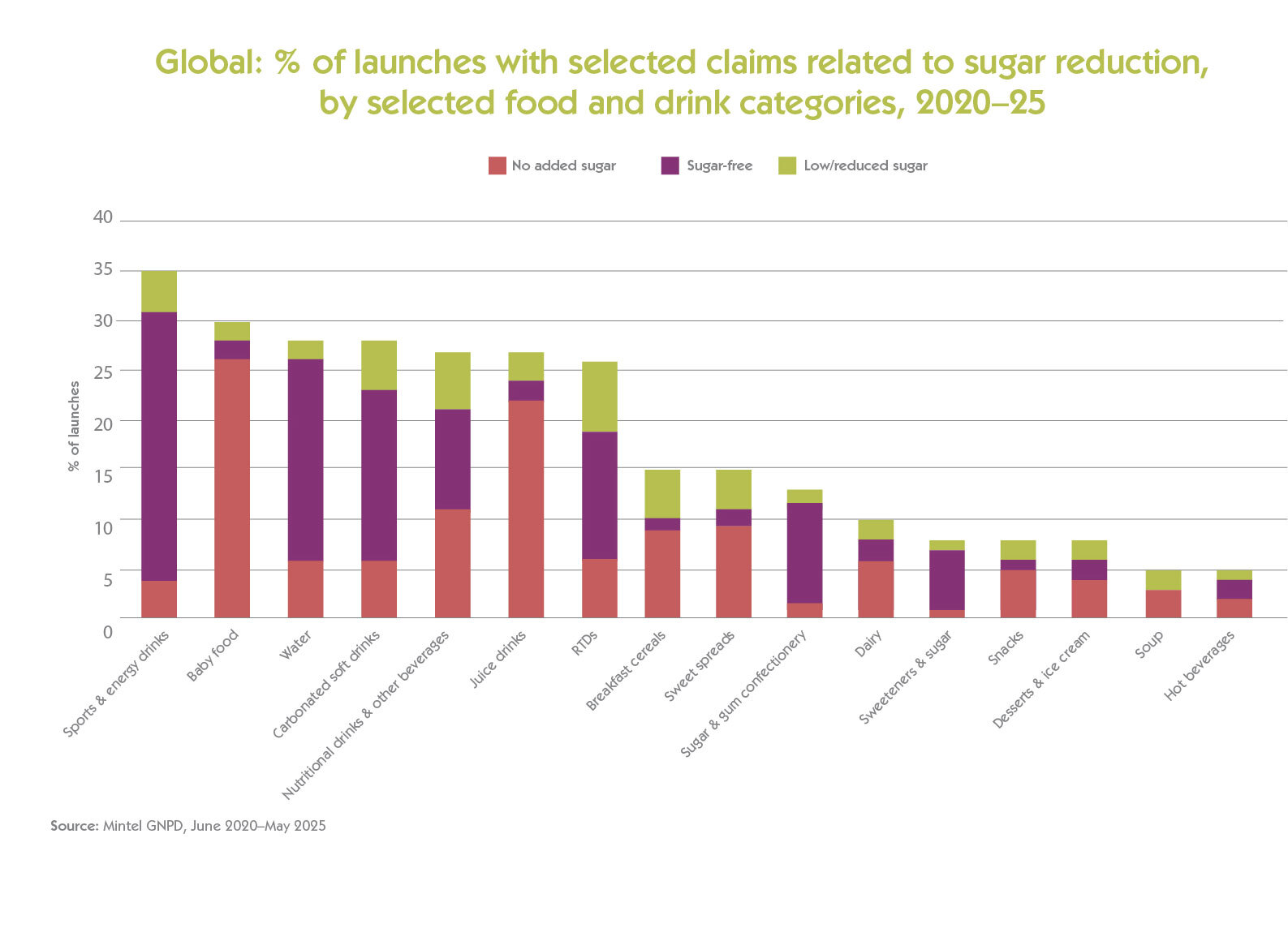
Sugar reduction trends manifest differently depending on the product category, meaning formulators must adapt their strategies to match category-specific expectations. Globally, sugar-reduction claims skew heavily toward the beverage space, specifically sports and energy drinks, flavored waters and carbonated soft drinks.3
The Prevalence of Claims Linked to Sugar Reduction Varies by Category
In sodas and carbonated soft drinks, sparkling juice drinks and energy drinks, consumers are more willing to accept artificial sweeteners to keep calories low, allowing manufacturers to use well-established artificial sweeteners to reduce sugar while maintaining or boosting flavor.2
Conversely, in categories like juices, hot teas and breakfast cereals, consumers expect sugar reduction to be natural. To build trust, brands must avoid artificial additives and can highlight ingredients that are intrinsically sweet and natural, like fibers that enhance flavor and provide fiber.2
Beyond Nutrition: Fiber’s Role in Sugar Reduction
When sugar is removed from a formulation, a product loses more than just sweetness. Sugar provides critical functional properties, like bulk, moisture retention and mouthfeel. To replace these properties, brands are increasingly using soluble fibers as more “natural” routes to sugar reduction.3
Soluble fibers serve as a multi-functional sugar reduction solution by:
- Building bulk and texture: Replacing volume and mouthfeel that sugar provides
- Enhancing sweetness: Blending with high-intensity sweeteners to round out the flavor profile
- Improving shelf life: Retaining moisture to maintain product freshness
- Appealing to consumers: Offering a recognizable, consumer-friendly ingredient that adds wellness appeal
The Fibersol® Advantage: Formulating Without Compromise
Fibersol® low-viscosity soluble prebiotic dietary fiber offers a strategic solution for replacing the functional properties of sugar while improving the nutritional profile of the final product.
Because it contains very few simple sugars, Fibersol® can:
- Help support label claims of low/reduced sugar; no sugar added; sugar free; and no/reduced calories
- Be used up to 15g (dry basis) in any application and still add approximately 0.30g of sugars (typical value) to any given formulation (15g Fibersol®-2 = 0.3g sugar, less than the FDA's 0.5g sugar content threshold for nutrition totals. Per the FDA: if a serving contains less than 0.5 grams of sugar, the content may be expressed as zero.)
Depending on the application, Fibersol® provides solutions for significant sugar reduction and noticeable calorie reduction, with the ability to reduce sugar up to 30%. In certain applications, Fibersol® may help facilitate close to 100% sugar reduction in conjunction with high-intensity sweeteners.
Fibersol®’s Key Sugar Reduction Benefits
- Blendability: Disperses and dissolves easily
- Compatibility: Works extremely well with most sweetener systems and helps mask bitterness, balance the flavor profile and improve mouthfeel. In beverages, it builds back mouthfeel and sweetness quality.
- Flavor: Provides no taste or aroma
- Structural Integrity: Restores bulk and structure in baked goods and snacks
- Nutritional Advantages: Allows brands to pair sugar reduction with highly desirable “good source” or “excellent source” fiber claims
- Well Tolerated and Clinically Backed: With over 30 years of clinical research, Fibersol® is proven well tolerated as high as 68 g per day
By integrating Fibersol® into reduced-sugar formulations, manufacturers can overcome the challenges of sugar reduction, delivering the clean labels, balanced nutrition and exceptional sensory profiles that keep consumers happy.
For sugar reduction inspiration, check out these case studies:
Frozen Dessert Without Added Sugars
Better-For-You Yogurt Smoothie
Better Than Ever Dried Cherries
Sources
1 International Food Information Council. 2025 IFIC Food & Health Survey: A Focus On Sugars & Sweeteners. December 2025.
2 Innova Market Insights. Global Consumer Approaches to Sugar Reduction. August 2025
3 Mintel. Patent Insights: Advancements in Sugar Reduction. July 2025